

Why is my emetophobia worse at night?
Many people with emetophobia often say that their anxiety is so much worse at night. This is not a coincidence but occurs for a really specific reason.
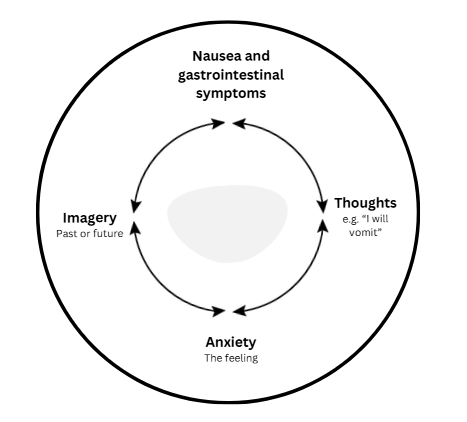
To explain why this occurs, we need to talk about a vicious cycle those with emetophobia often fall into when they encounter a triggering situation. This cycle is made up of 4 areas and each symptoms starts a chain reaction.
These areas are:
Anxious thoughts about being sick.
The feeling of anxiety.
Physical symptoms (such as nausea)
Mental images or memories of being sick.
Each one of these areas can be scary for those with emetophobia. But what is worse is they all link with each other and cause the other symptoms to increase. For example, thoughts about being sick, will trigger, anxiety and nausea etc. Or, if you notice nausea, then that can trigger thoughts and anxiety. And so on.
It often looks similar to this:
Why is night-time worse for anxiety?
The thing about night-time is that it allows these four areas to activate more easily.
When lying in bed:
1) It is easier for the mind to wonder and cause anxious thoughts.
2) Because you are still, it is easier for you to notice stomach sensations or nausea.
3) When you have your eyes closed, it is easier to see anxious mental imagery in your mind.
4) Nothing is distracting you from the feeling of anxiety.
So at night, it is much more likely that at least one of these symptoms occur. This starts that chain reaction.
How to improve night time anxiety?
There is a concept in therapy which states that people are not bothered by an event but the meaning we place onto the event.
For example, if you are on a treadmill and your heart is racing, you are not bothered because you know why it is happening. However, if you are lying still in bed and your heart starts to race without a known reason, then it is possible to have anxious thoughts such “i am having a heart attack”. Same symptom, different meaning, and a very different outcome for your anxiety.
This is the same for those with emetophobia. For example:
If the meaning you place on your anxious thoughts is that “they must be true" and “it is going to happen” then you will feel anxious. If the meaning is “that is a random thought” and “it doesn’t mean it is going to happen”, the same thought becomes less scary.
If the meaning you place on anxiety is “it must be a sign that something bad is happening” then you will always panic when anxious.
If the meaning you place on physical symptoms (such as nausea) is that “it must mean I have caught something or eaten something bad”, then you will panic.
If the meaning you place on mental images or memories of being sick is that it is a premonition of what is to come, then you will panic.
So, to help with this, you need to become more aware of the fact that these symptoms are being caused by it being night-time and not a sign that you are sick. If you change how you view these symptoms, then you change how you feel about them.
So:
Thoughts: You need to learn it is okay to have thoughts and that having thoughts about being sick, is not the same as being sick.
Anxiety: You need to learn to not see anxiety as a problem or a sign that something bad is happening.
Nausea : You need to learn that the sensations are most likely benign and caused by you just being more aware of your body.
Mental images: You need to learn mental images are safe and not a sign of what will happen
The best way to achieve this is to stop reacting or acting upon these symptoms. Only that way do you realise that these symptoms are safe. Its sounds tough, but do nothing and see what happens. Each time you react, you only learn to be afraid.
Therapy for night time anxiety:
Night time anxiety sucks. It really does. It can be hard to do nothing in response to these symptoms. I work with those with emetophobia on a daily basis. They, and you can learn to overcome their night-time anxiety. If you are interested in private therapy, reach out.