

What is exposure therapy?
Exposure therapy is a tool used to help overcome anxiety and fear, especially when we attempt to avoid the things causing us anxiety.
With any fear we have, the more we face it, the less scary it becomes. Let’s talk about why. It is often easier to see how these principles apply when its not about ourselves. So we are going to use a made up fear. Imagine someone named Sophie who is scared of a Griffin. A Griffin is a legendary creature that has the body, tail, and back legs of a lion, and the head and wings of an eagle. This cute little guy!

The effect of escaping our fear:
Let’s imagine that Griffins are harmless creatures but Sophie is really afraid of them because she fears they might bite her.
One day Sophie visits her friends’ house to discover that their friend just got a pet griffin.
What do you think happens to the Sophie's anxiety? It most likely shoots up. Why might that be? What do you think Sophie is thinking?
She is most likely focusing on the danger and having thoughts like “the griffin is going to harm me”.
So to avoid “the danger” what might Sophie be likely to try and do?
Avoid!
Run!
Escape the room somehow!
Or do something to keep herself safe.
When someone escapes the thing they fear, their anxiety quickly reduces. We see this pattern → Anxiety increases when they see their fear and quickly reduces when they escape it. Looking a bit like this graph:
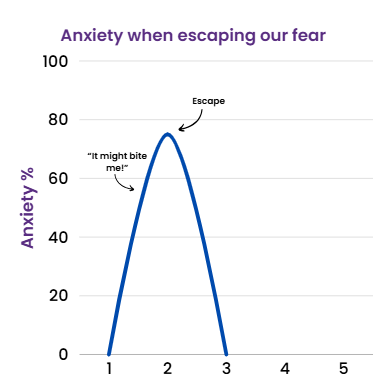
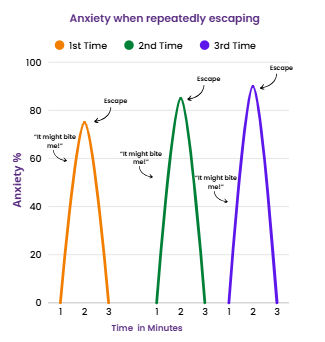
The problem is that the next time they face their fear, they want to escape again. Over time this grows their fear. You see this pattern over and over. Sophie never learns to overcome her anxiety.
The second problem with avoiding is that we never get to see if our fear occurs or not. Sophie remains convinced that the Griffin would have bitten her because she never gets the opportunity to disprove what her thoughts were telling her. Despite the Griffin being friendly and that Sophie was never in any danger, she felt in danger.
Each time we avoid we only grow and maintain our fear. Looking like this graph:
Consider how this avoidance might apply to you avoiding reminders related to your emetophobia? (words, images, sounds, videos etc).
Exposure therapy:
The best way to overcome avoidance is using exposure therapy. Exposure therapy is when we force ourselves to confront our fear without escaping, avoiding or doing anything to prevent out fear. Although this sounds scary, most people find it much easier than they think it is going to be.
How does it work:
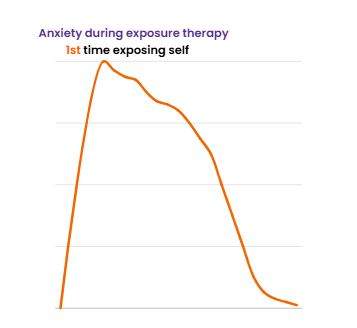
Let’s imagine Sophie with the Griffin again. She decides that she needs to face her fear, and so visits her friend and forces herself to stay in the room with the Griffin. Her anxiety quickly rises as she see the Griffin and she has the worried thought “what if it bites me!”.
But she push through it. After a while of watching the Griffin, nothing bad has happened yet. Her anxiety reduces slightly. Then more time goes by and the Griffin has still not bitten her. Sophie’s anxiety reduces more. This pattern keeps repeating until the Sophie realises she is safe and her anxiety disappears. This can be seen on the orange line on this graph. It increases then slowly comes down.
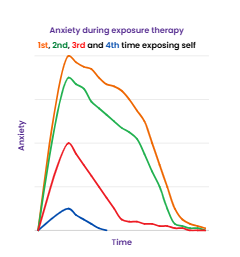
The next day, Sophie decides to do it again to really overcome her fear. Sophie’s anxiety increases when she see’s the Griffin because she wonders “what if last time I was just lucky and it bites me this time?”. But she is not as anxious as she remember yesterday went well. Again the Griffin doesn't bite Sophie and her anxiety slowly comes down. Sophie tries again the next day. Her anxiety is much lower after having multiple positive experiences. And then she tries it a fourth time and she barely experience any anxiety. She have finally learnt Griffins don’t bite. Each time got easier and less scary. This can be seen on the graph.
Scary Movie Analogy: Let's show how exposure works in action. Imagine the scariest horror film imaginable. When you watch this you watch in horror, terrified. Now, imagine you watch the same film the next day. Is it going to have the same impact on you? What about, if you watch it the day after that as well, and the day after that. At some point, you will no longer be scared because you have repeated it so many times.
Making exposure work:
Exposure therapy needs a few things to make it the most effective.
1) Predictions: Before exposing yourself to your fear you need to write down what it is you are afraid of (what negative thing you think is going to happen). This way you can reflect on these predictions after you try it. For example Sophie was predicting “the griffin will bite me”.
2) Prolonged: You need to exposure yourself long enough to either prove or disprove your predictions. If Sophie walked into a room with a griffin and only stayed for 2 minutes then its unlikely they would learn anything. She would have only learn it was safe to be in the soon for 2 minutes. The longer the better. Stay until you are not anxious. I would recommend staying until you are bored.
3) Without safety behaviours: Safety behaviours or any form of distraction have a nasty way of distorting our learning by all sorts of mental gymnastics. Imagine if Sophie was feeding the Griffin treats constantly so it “stays happy and doesn't bite her”. She would convince yourself that “a happy and well fed Griffin doesn't bite”. So she would still be afraid of them despite doing her exposure task. So ensure you don't use any checking, reassurance seeking or other safety behaviours.
4) Repeated: Exposure needs to be repeated or you might use mental gymnastics to say you only got “lucky” that time. Do it until you are bored. Usually, if you avoid all safety behaviours and stay long enough, you only need to exposure yourself to your fear 4 times.
Planning for your exposure:
Consider all of the ways you are avoiding any cues or reminders of your fear.
This might be:
Skipping over social media videos.
Not watching certain films or shows.
Changing the channel.
Avoiding conversations.
Avoiding words, cartoons, pictures, sounds or videos.
Make a list of things you avoid . These are the things you can expose yourself too.
The purpose is not to be happy with the content, but to realise you can do it without anxiety and that nothing bad occurs.
Visit my free emetophobia self-help page to read more about avoidance and exposure therapy. -> Free Emetophobia self-help — Kaneria CBT Therapy